Electronics Workbench: Difference between revisions
Adamcolton (talk | contribs) No edit summary |
Adamcolton (talk | contribs) No edit summary |
||
| Line 3: | Line 3: | ||
http://www.instructables.com/id/Make-a-Portable-Workstation/?ALLSTEPS | http://www.instructables.com/id/Make-a-Portable-Workstation/?ALLSTEPS | ||
I want to build 3 separate pieces. | I want to build 3 separate pieces. One just for carrying parts. One for tools, soldering in particular. The last is for breadboard prototyping. | ||
== Tools == | == Tools == | ||
Revision as of 15:17, 22 April 2016
http://brianzawesomeblog.blogspot.ca/2014/03/mobile-electronics-workbench.html
http://www.instructables.com/id/Make-a-Portable-Workstation/?ALLSTEPS
I want to build 3 separate pieces. One just for carrying parts. One for tools, soldering in particular. The last is for breadboard prototyping.
Tools
- Wire cutters
- soldering iron
- fume extractor
- jewelers screwdrivers (I could get another like my backpack)
- multimeter
- needle nose pliers
- tweezers
Incorporated
- magnifying lamp
- wire spools
- ac outlets
- clamps
Advanced Breadboard
I saw this (look for "circuit design trainer") and I'd like to build one. Slightly angled platform with the breadboard fixed in the center. Around the perimeter were some useful tools. Power supplies, logic grid (lights for high/low), speaker, function generator, debounced buttons, switches, pots. I'd probably want a drawer to hold the jumper wires. Maybe add 9V out with a 9V lead to connect to a multi-meter.
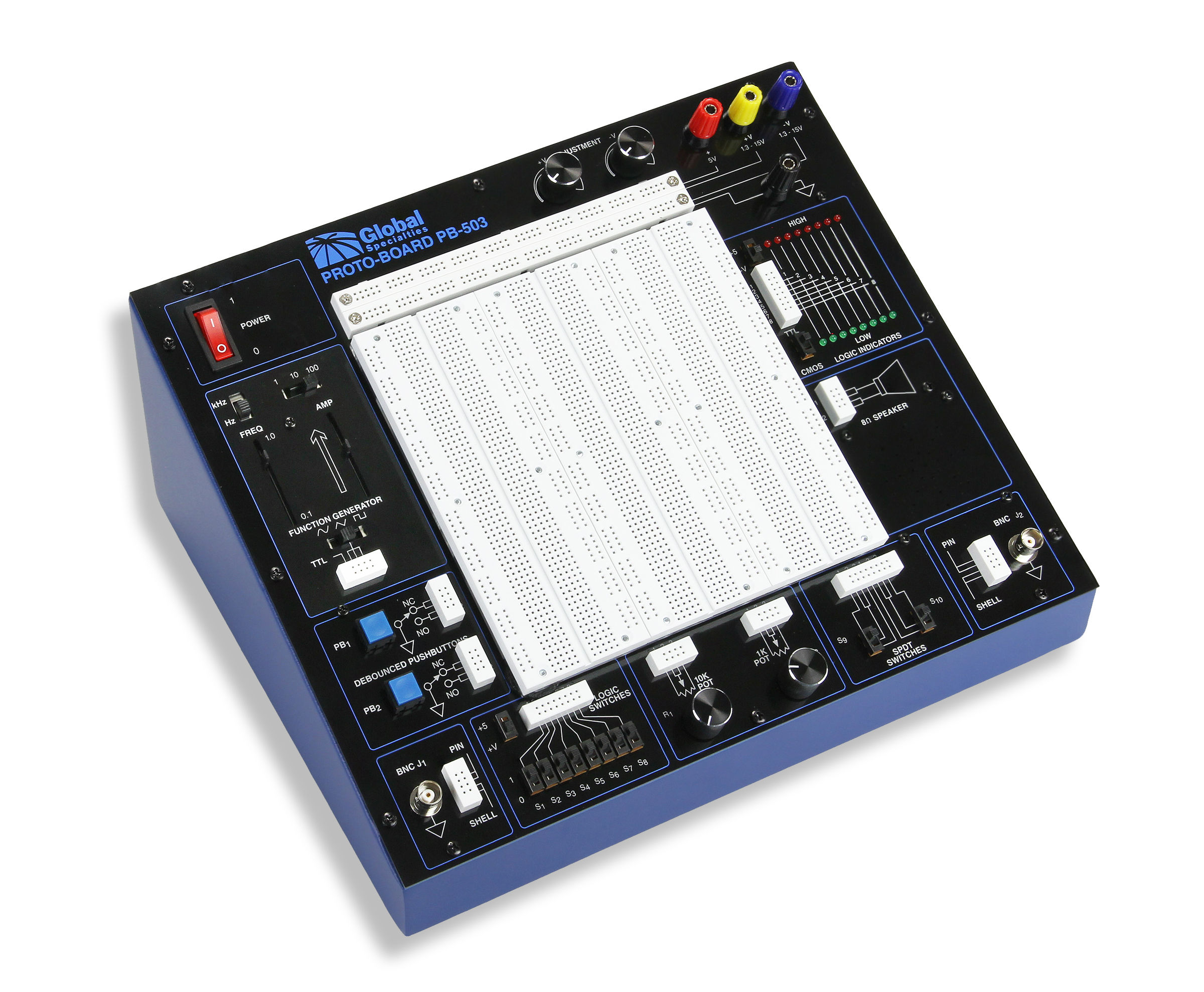
Slightly angled platform with space for 3 standard breadboards. Breadboards have tabs in the side to link them, we'll use that to hold them in place. That also means they can be swapped out, so I'll get ~6 of them. The board will have one global ground bus and 3 Vcc bus, each with it's own power switch, fuse, adjustment and voltage display. The board will have one standard barrel connector. There will be ground and Vcc terminals for each breadboard rail, though they will be shared by adjacent boards.
For peripherals, LEDs, buttons, switches, pots. The peripherals will have 2 terminal groups, between the bread boards. The LEDs will be in two banks - high and low. I'll put a linear regulator in current limiting mode for each of them (probably an LM723).
Terminal layout, everything is 3 wide. I'll put the labels under the center board, and assume I won't need all 3 very often.
- LEDs 6 high, 6 low
- POTs 3 pots, 3 each for 9
- 4 Buttons, 8 terminals
- 8 switches 16 terminals
Total: 45x3
A breadboard is only 60 terminals long, so it would almost make sense to just use a breadboard to wire this up.
I can put a storage spot in the side for jumper wires.
I'd like the structure to fold up, the peripherals on the "wings", leaving enough space inside for parts. But I don't know how thick it would be and I'm not sure how the wiring would work with the hinges.